April 13, 2026
Custom-made furniture, why choose craftsmanship?
Factory furniture versus furniture from a craftsman's workshop. We explain the differences in quality, materials and process. What makes one table cost three thousand and another thirty.
Mass-produced versus custom-made furniture
A table from a big-box store costs 800 zloty and looks like thousands of others all across Poland. A craftsman's table costs from a few to several dozen thousand. Where does the difference come from? Not from margin, but from a fundamental difference in how the piece comes into being.
Mass-produced furniture is a product of the assembly line. Identical boards, the same dimensions, the same machine processing, the same lacquer. The goal is to minimise unit cost and maximise scale. Material is selected for availability and predictability. Often it is MDF or HDF board with laminate that imitates wood. Sometimes veneer glued onto a plywood core.
Craftsman's furniture is a project. Every element comes from a specific log whose structure is one of a kind. The carpenter works with material that has its own history and character. He adapts his work to what nature has provided, not the other way around.
What determines quality
Three elements draw the line between cheap furniture and premium furniture:
Material. Solid wood versus chipboard. Bog oak versus ordinary factory oak. Wood from a certified source versus anonymous raw material. The cost of the material in a craftsman's piece often makes up 40 to 60 percent of the total value of the table.
Working time. A machine packs out a store table in a few hours. A craftsman works on a single piece for four to seven weeks. Sanding a single board alone averages 35 hours of work. Each finishing layer requires drying, polishing, and inspection under different lighting.
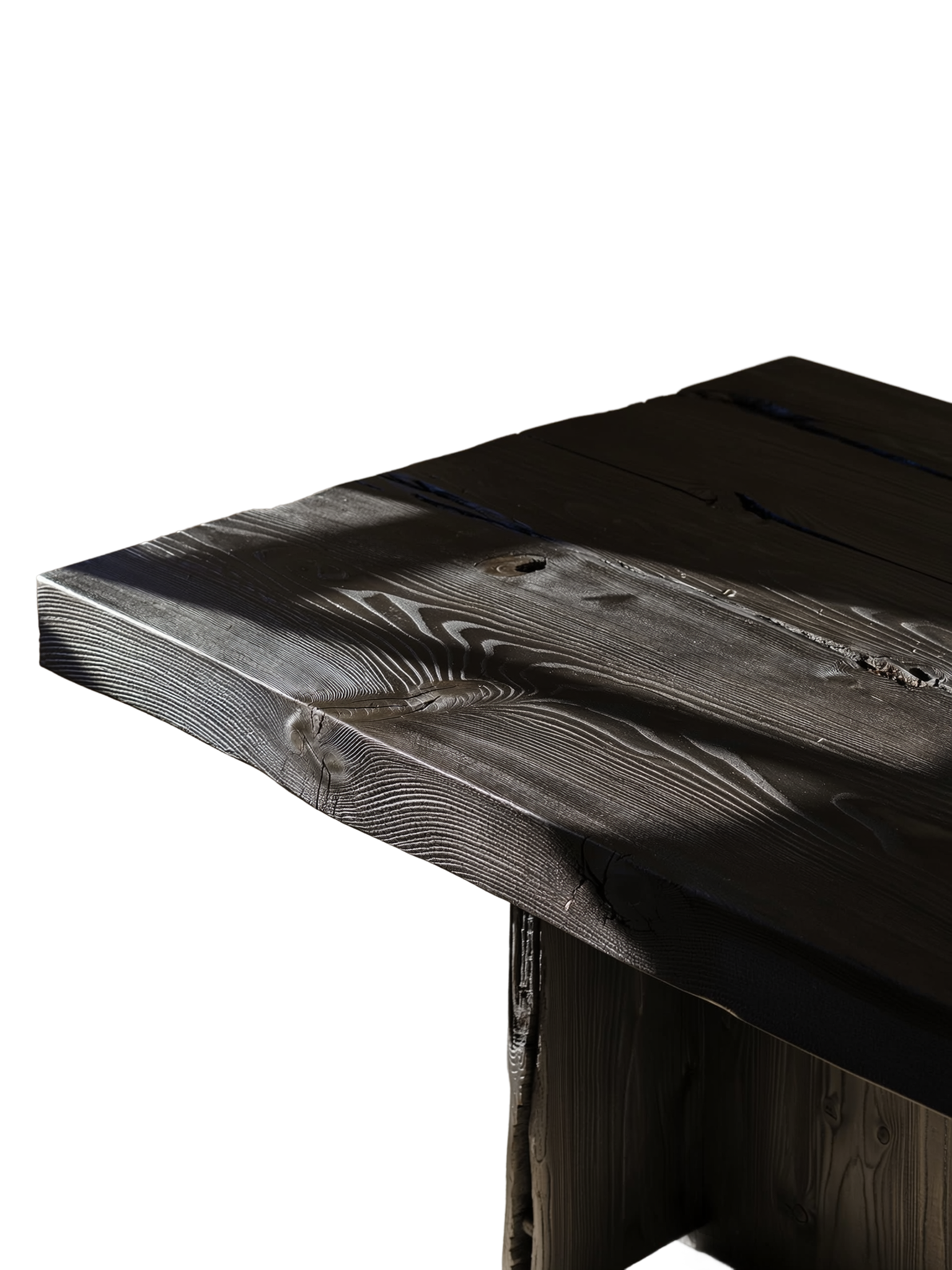
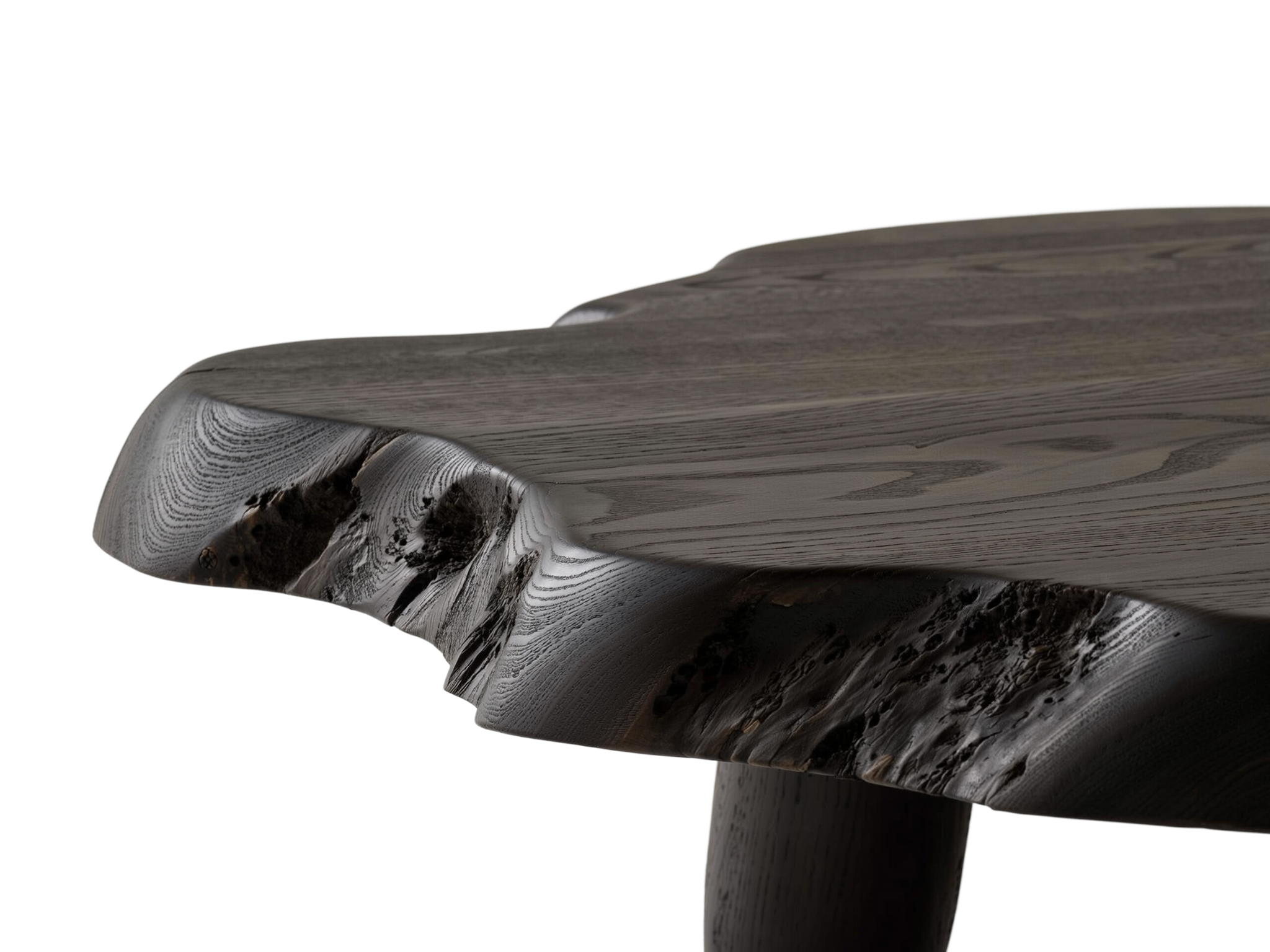
Finishing. Mass-produced furniture has a uniform, smooth lacquer. A craftsman's piece preserves the structure of the wood. The grain is visible and can be felt under the fingertips. The edges are not formulaically straight, they emphasise the natural character of the material.
Hand-finishing bog oak
Wood pulled from a river or peat bog needs 7 to 10 years of drying before it ever reaches the workshop. After that time, the work begins.
First the carpenter assesses the log and decides how to cut it so the natural grain is shown to its best. A cut along the grain yields long, regular boards. A cross cut reveals the section, with its characteristic age rings. The choice depends on the design of the piece.
After cutting, the boards are levelled with a thicknesser, but only roughly. The rest is hand work. Planes, drawknives, finally sandpaper in more than a dozen progressively finer grits. The final sanding, at 2000 grit, produces a surface as smooth as glass yet still alive with texture.
Finally the finish. Oil, wax, sometimes a thin layer of lacquer. Every coat needs drying time. Every layer brings another round of polishing. After five or six cycles the wood reaches a colour and depth that no production line can recreate.
Personalisation
Custom-made furniture is built for a specific space and specific needs. Dimensions do not have to follow catalogue sizes. A table 240 by 90, unusually long but narrow, fits into a dining room where a standard 200 by 100 would make moving around difficult.
You can adjust:
- The dimensions and shape of the top, oval, rectangular with rounded corners, or irregular with a raw edge.
- The height, since for very tall or very short people the standard 75 cm can be uncomfortable.
- The type of legs, solid wood, metal hairpin, forged, or monolithic resin.
- The finish and resin colour if the piece includes such elements.
- A detail, such as an initial, date or coat of arms hidden in an inconspicuous spot.
Warranty and certificate
A craftsman's piece comes with paperwork. A wood origin certificate showing the extraction site. A C14 certificate with radiocarbon dating. A serial number and an entry in the workshop's register. A five-year warranty against defects in workmanship and material.
Furniture from a big-box store comes with a tag and a barcode. A year later, when the laminate starts peeling, there is no one to call. The manufacturer has already changed its entire line.
Conclusion
Craftsman's furniture is not more expensive without reason. You pay for material that cannot be reproduced, for working time that cannot be compressed, and for knowledge that cannot be automated. In return you get a table that will last for decades and grow more interesting, not worse, with each passing year.
Konrad Wojtusiak
CEO Oriolus Woodcraft
About Oriolus Woodcraft — tables made of black oak combining craftsmanship and emotion. Brand creator with a passion for author-driven design and authenticity.
Did you like the article? Share it